


The existing family entertainment competitive market has experienced the indoor playgrounds being not only fun but also strategic investments. The soft play zone focuses on toddlers and preschoolers who are drawn to sensory richness and low impactfulness of the play, as opposed to modular play structures which draw a more diverse group of people with climbing towers and mazes.
Soft Play vs. Modular Indoor Equipment
Age Appropriate
Toddler soft play is specifically meant to toddlers of between 6 months to 5 years old. Such areas are cushioned, have low floors and smooth edges that make exploring them safe. Soft play construction is foam-based, so this construction is ideal when it comes to young learners who are still mastering the art of balance and coordination.
Modular indoor playgrounds have a wider range of age groups (3-12 years) and have elevated tunnels, climbing nets, and slides. These systems encourage more challenges and playing. The hybrids which are appealing to most operators are offering soft play areas to the toddlers with more age-specific areas to the older kids to create multi-age groups
Design & Materials
The architecture of the indoor soft play equipment aims at sensorial interaction and safety. The spaces are equipped with foam cushions, vinyl sheets, padded mats which are used to avoid injuries. The color and surface as well as the soft designs are very vivid, and they trigger the visual and tactile sense of the children in the play.
Modular indoor play equipment, on the contrary, is attentive to the strength in the structure and durability. The modular systems consist of high-density plastic and PVC-covered galvanized steel frame platforms that are highly stable for climbing, sliding and running. The modular form of design of the play entails a uniform approach towards the modules and can thus be simply extended and reconfigured

Space Planning & Ceiling Height
An effective planning is pertinent in decision making on soft plays and modular implementations. Daycares, shopping mall areas, and early learning centers should be the best places in which indoor soft play equipment should be installed because they are small areas with low ceilings. The systems are average in ceiling heights (8-10 feet) and can use a small footprint.
The indoor playing equipment that is offered in a modular system are also more suited in larger areas where the ceiling is higher- usually 12- 20 feet or more. The multi-level layouts that incorporate the modular play system design including the bridges, rope tower and enclosed slide are aesthetically attractive and contribute play values. The operators should also have circulation zones and safety
Installation, Scalability & Upgrades
The soft play installation is very problematic in relation to scalability and complexity of installation in comparison with the modular play installation. Soft play equipment’s require days to be installed as compared to weeks since most systems can be installed within the minimum time possible.
Indoor play equipment is, on the other hand, more robust to install, especially the modular ones. Multi-layer frame, anchored frame and enhanced safety system requires hiring a team of professionals to carry out the installation. This is desirable since it is scalable with scalable modules of play standards, which have the prospects of being scaled up in terms of vertical and horizontal expansion of the business.

Durability & Maintenance
Durability is an aspect that is a characteristic aspect of comparing indoor play equipment. Soft play systems are created as younger users and are made from foam cores that are encased in commercial grade vinyl. They are simple to wash and service yet they must be checked regularly to prevent wear and tears that may arise due to frequent use. In the case of a high-traffic venue, surface covers should be changed after every other few years.
On the contrary, the modular indoor play equipment is the one that is highly durable. This is owed to steel frames, reinforced joints and heavy-duty platforms which allow them to be accommodating of the elderly children and may be used continuously. Once the maintenance is typically regular inspection, slide and tunnel cleaning and hardware tightening.
Play Value & Developmental Outcomes
Toddlers play devices are primarily aimed at helping small children to develop cognitively, physically and socially. The two soft play benefits and the modular play benefits are connected to the enhancement of the developmental outcomes albeit differently.
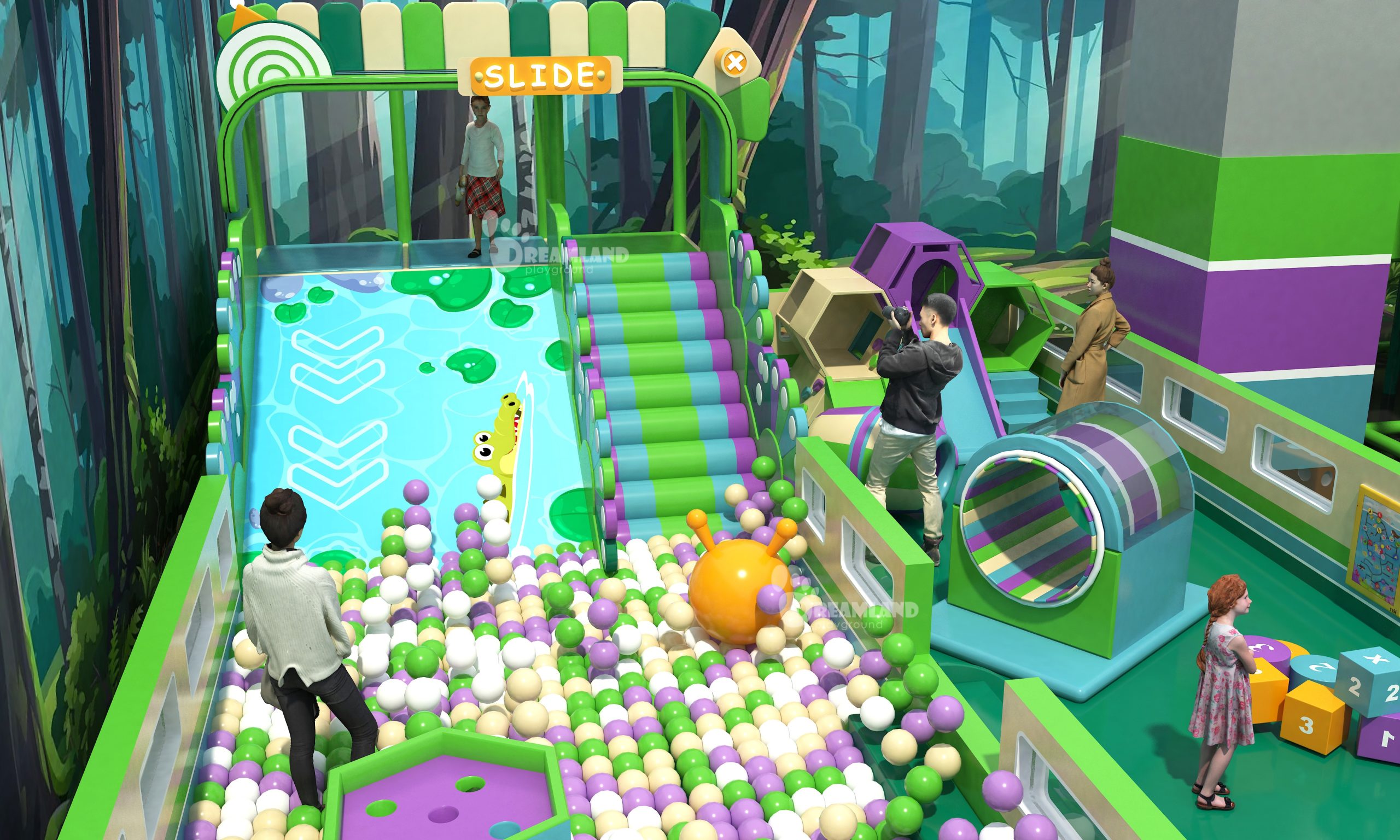
With the assistance of soft play equipment, simple motor skills, balance and exploration of the tactile environment are encouraged. Facilities on the ground, including climbing ramps and ball pits, give toddlers an opportunity to live in their environment with no threat of getting injured and enhance self-esteem, as well as motor skills.
On the other hand, modular play systems indeed pose more challenges which are more intricate and thus stimulating to cognitive development. Children plan, solve problems, and work together on such aspects as climbing walls, ropes, and obstacle courses. These disorders enhance executive functioning skills, including planning, attention and restraint, that proved to be important in the future learning processes.
The modular play systems serve as an arena in sharpening the motor skills and cognitive reasoning in the case of older children which are in accordance with the topics in other subjects such as physics and geometry. The systems can provide long term play value and facilitate learning in the form of play STEM programs in the long run as the children grow up.
Cost
Both soft play equipment’s and modular play equipment pricing vary across the board depending on their size and complexity of the installation including the material used. Prices of soft play equipment would probably be low, especially in small establishments or temporary installations. They are easier to set up and what is more is that they do not require much structural infrastructure.
The price of modular play systems is also higher in the outlay due to the complexity of the material, construction, and installation. They are, however, meant to be long-lasting and can be extended or upgraded in long term and this is a long-term value. Flexibility in modular play allows facilities to adjust their offerings as customer requirements evolve and is a very good investment in a huge play area or children entertainment park.

Risk and Liability
The modular play systems and the soft play systems also have varying safety issues that affect the risk and liability. The play activities that will be performed by the toddlers will be less risky, as the playground will be designed in such a way that it will be using padded and low impact design, which will reduce the risk of injury.
On the other hand, modular play systems have heavier physical activities like climbing and upwards, which can cause a fall or even get struck. Scrutiny of such systems should be done in respect to the safety measures like construction, good fall zones and good installations. Regular safety checks and maintenance are also necessary to ensure that the standards of safety have been adhered to as well as reduce liability suits.
How to Choose?
The decision on whether to use soft play or modular systems in your play area highly depends on what you are intending to do, what space you have and the type of audience or target market and your budget. Indoor and small settings would be most suitable in using the soft play equipment in which the toddlers are the prime users. These machines are cheaper, easy to install and are suitable for such features as daycare facilities or playgrounds in small shopping malls.
On the other hand, the Modular play systems are appropriate in the area or venue where there is a bigger target audience or population. Through these systems, more complicated physical activity and facilitation of critical thinking, social interaction and collaboration are supported. All-age modular play is suitable to a broad age group of children to 12 years of age, and, therefore, is best suited in family entertainment centers (FECs), parks or massive indoor playgrounds.

Conclusion
Choosing play equipment for toddlers is an important consideration in creating a fun, safe, and developmental play experience. TopKidsPlay specializes in providing customized playground solutions that cater to your unique needs. With expert installation and comprehensive warranties, we ensure the best possible experience for your toddlers. Reach out now to design the perfect playground for your toddlers!
FAQs
Are toddler soft play areas safe with sensory sensitive toddlers or special needs?
Yes, soft play equipments are especially advantageous to sensitively sensorial toddlers. The squashy flooring and no impact facilities make it an inclusive environment with all children.
What should the indoor play systems do to facilitate inclusivity and access by all children?
Soft play and modular play systems can also be made with features that are easy to use including ramps, sensory panels, and adaptive swings, so that all children can join in and play.
Is it possible to use soft play or modular arrangements in outdoor cases?
Indeed, modular play systems can be both an indoor and an outdoor program. The soft play equipment is normally used in the indoor environment, but there are some strong and weatherproof types of equipment, which can be used outside, especially in parks.


